With the Gameweek 5 deadline at 21:30 on Friday 18 September, the useful question is not “who is this week’s must-have?” It is whether your next move improves the squad beyond one deadline. A simple transfer plan keeps you out of the Friday-night panic loop: check the fixtures, understand your bank and free transfers, then commit only when the move still makes sense for the next few gameweeks.
This is a process-first guide for FPL managers in UK mini-leagues. It deliberately avoids pretending we can predict every line-up, injury or price swing. Instead, use the free FPL Planner to turn the information you already trust into a clear GW5 decision, while leaving enough flexibility for GW6.
Start with your squad, not the transfer market
Open your current team and write down the facts before browsing replacements. How many free transfers do you have? How much money is in the bank? Which players are carrying a flag, rotation risk or a difficult run? Is your bench playable if a starter misses out? This short audit prevents the classic mini-league error of making a transfer simply because a player returned points last week.
Next, separate problems into three groups. A must-fix is a player you cannot reasonably start, a non-starter with no bench cover or a player whose minutes situation has materially changed. A nice-to-fix is a weak fixture or an awkward booking that can wait. A watchlist item is a possible move that needs another week of information. Your one free transfer should normally solve the first group, not chase the third.
Use the planner to map GW5 and GW6
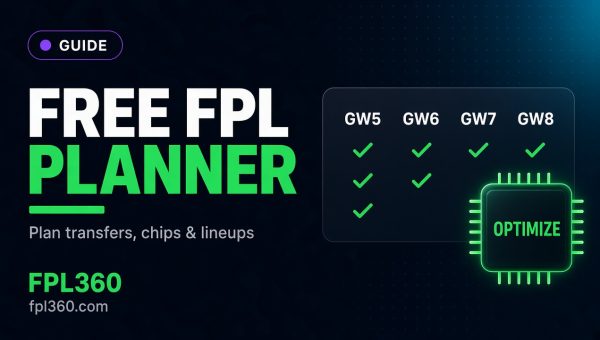
In the planner, add your likely transfer and look at the squad across the next two gameweeks. Check the starting XI, bench order and captaincy options without treating the tool as a prediction machine. The value is seeing the consequences together: a move that looks good in isolation may leave you short on a later fixture, remove a useful bench player or force another transfer next Friday.
Build a small shortlist rather than ten hypothetical drafts. Compare your current player with two or three realistic alternatives at the same position and price range. For each option, ask four questions: will the player start often enough, does the fixture run support the move, can I field a balanced XI next week, and would I still want this player if the immediate fixture were removed? If the answer is only “because of this week,” hold the transfer in your notes.
Fixtures are a guide, not a decision by themselves
Use the fixture rotation tool to spot where your squad has cover and where two positions may clash. Rotation is most useful for comparing blocks of fixtures, not for declaring that one defence is automatically better. Check home and away context, likely minutes and your own formation. A bench player who reliably covers a difficult week can be more valuable than a theoretical upgrade that leaves the rest of the squad exposed.
Keep the transfer plan robust to late news. If you are unsure about a flagged player, do not build a complicated move that depends on one early team sheet. Make a first-choice move, a sensible fallback and a deadline check. Avoid hits unless the additional match time and squad improvement clearly justify four points; early-season ranks are won over a run of decisions, not by forcing action every Friday.
A calm deadline workflow
Use this order before the GW5 deadline:
- Review injuries, suspensions and credible team-news updates.
- Confirm your free transfers, bank and starting XI.
- Run the current squad through the planner, then compare only your shortlist.
- Check the next two gameweeks and your bench after the move.
- Set the captain, vice-captain and bench order, then save a fallback.
- Make the transfer only after the final information check.
For a second opinion on the available tools, see our FPL tools hub. It is also worth reading the free FPL Planner guide if you have not used the planner before. The aim is not to outsource your judgement; it is to make the judgement easier to audit.
Think like a mini-league manager
Your rivals change the context, but they should not control every decision. If you are leading, protecting a solid structure and avoiding unnecessary hits may be the best edge. If you are chasing, identify the positions where you can gain without needing an unlikely haul. In both cases, compare your plan with your rival’s likely move only after checking your own squad. A sensible, repeatable process beats a dramatic punt that creates two new problems.
GW5 is still early enough to preserve flexibility. You do not need a perfect team today. You need a starting XI you trust, a bench that can cover the obvious risk and a clear reason for any transfer. Map the move in the planner, test it against GW6, and keep the final decision grounded in minutes, fixtures and squad balance rather than noise.
Ready to plan? Open the free FPL Planner, compare your GW5 move with the GW6 follow-up, and return to the deadline checklist before you confirm. That small pause is often the difference between a transfer that merely reacts and one that helps your mini-league season.