
FPL Points System Explained: How Fantasy Premier League Scoring Works
Understanding exactly how points are awarded in Fantasy Premier League is fundamental to making informed decisions about your squad. While most managers know that goals and assists earn points, the full scoring system is far more nuanced than many realise. From the intricacies of the Bonus Points System to the often-misunderstood rules around clean sheets and saves, a thorough knowledge of FPL scoring gives you a genuine edge over less informed managers.
This guide provides a complete, detailed breakdown of every way a player can earn — or lose — points in FPL, along with the mechanics behind the Bonus Points System that awards additional points after every match.
Basic Scoring: Minutes Played
Before any other points are calculated, a player must actually take the field. The scoring for appearance is as follows:
- Playing up to 60 minutes: 1 point
- Playing 60 minutes or more: 2 points
This is the foundation of all FPL scoring. A player who comes on as a substitute in the 89th minute earns 1 point for their appearance. A player who starts and is substituted off in the 58th minute also earns just 1 point. Only players who reach the 60-minute mark receive the full 2 points.
This distinction is important when selecting your squad. Players who are regular starters and consistently play the full 90 minutes have a higher scoring floor than those who are frequently rotated or used as substitutes. A guaranteed 2 points per gameweek may not sound like much, but over 38 gameweeks it amounts to 76 points — a significant baseline.
Goals Scored
Goals are the primary source of attacking points in FPL, but the number of points awarded varies by position:
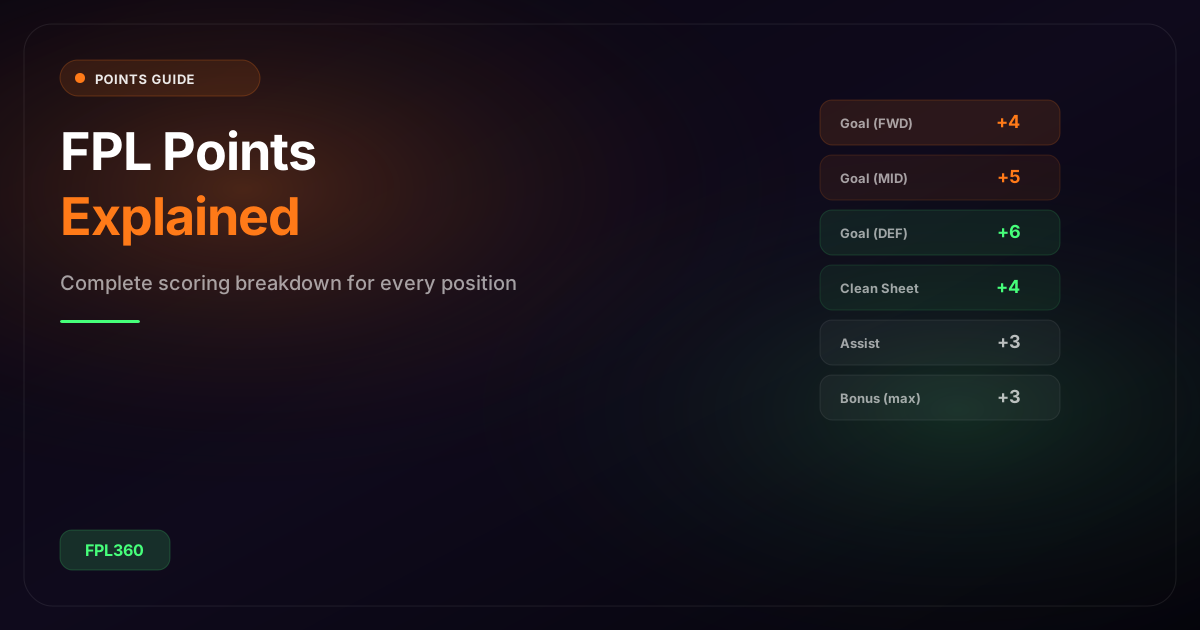
- Goalkeepers: 6 points per goal
- Defenders: 6 points per goal
- Midfielders: 5 points per goal
- Forwards: 4 points per goal
This tiered system is one of the most important features of FPL scoring and directly influences squad-building strategy. A goal from a defender is worth 50% more than a goal from a forward. This is why attacking defenders and wing-backs are so highly valued in FPL — they combine defensive clean sheet potential with premium goal-scoring points.
Similarly, players classified as midfielders in FPL who play as forwards in real life (often called “OOP” or out-of-position players) are extremely valuable because they earn 5 points per goal rather than the 4 points they would receive if correctly classified as forwards.
What Counts as a Goal?
Only goals that are awarded to a specific player by the Premier League’s official statisticians count for FPL purposes. Own goals scored by opposition players do not earn points for the attacking player. Penalty goals count the same as open-play goals. Goals scored in normal time and stoppage time all count, but goals scored in penalty shootouts (which do not occur in the Premier League) would not.
Assists
An assist in FPL earns 3 points regardless of the position of the player providing it. However, the definition of an assist in FPL is broader than the official Premier League definition, which catches many managers off guard.
FPL Assist Rules
An FPL assist is awarded to the player who makes the final pass or cross leading to a goal. However, FPL also awards assists in several additional scenarios:
- Winning a penalty: If a player is fouled in the box and a penalty is subsequently scored, the fouled player receives the assist (unless they take and score the penalty themselves, in which case no assist is awarded).
- Shots that lead to rebounds: If a player takes a shot that hits the woodwork or is saved by the goalkeeper, and another player scores from the rebound, the original shooter receives the assist.
- Deflections: If a pass is deflected by an opposition player before reaching the goalscorer, the original passer may still receive the assist, provided the pass was intentionally directed towards the goalscorer.
These extended assist rules mean that players who take a lot of shots (generating rebound opportunities) and players who win penalties are more valuable than traditional assist statistics might suggest. When evaluating potential transfers, consider not just a player’s assist tally but also their shots on target, shots that hit the woodwork, and penalties won.
Clean Sheets
Clean sheet points are awarded when a team does not concede a goal during a match. The points vary by position:
- Goalkeepers: 4 points for a clean sheet
- Defenders: 4 points for a clean sheet
- Midfielders: 1 point for a clean sheet
- Forwards: 0 points for a clean sheet
The 60-Minute Rule
A player must play at least 60 minutes to be eligible for clean sheet points. This is one of the most frustrating aspects of FPL for many managers. If your defender plays 59 minutes and is substituted before the hour mark, they receive no clean sheet points even if their team keeps a clean sheet. Conversely, if a defender comes on as a substitute in the 30th minute and plays until full time without a goal being conceded, they earn the clean sheet bonus.
When Clean Sheets Are Lost
A clean sheet is lost the moment a goal is conceded. If a defender plays 70 minutes and is substituted off with the score at 0-0, but the opposition then scores in the 85th minute, the defender still receives their clean sheet points because the goal was conceded after they left the pitch. This rule works in defenders’ favour and is worth considering when assessing players who are occasionally substituted early.
Goals Conceded (Goalkeepers and Defenders)
Goalkeepers and defenders lose points for every two goals their team concedes:
- Every 2 goals conceded: -1 point
This means that if a team loses 4-0, their goalkeeper and defenders each lose 2 points for goals conceded. Combined with the loss of the clean sheet (0 points instead of 4), the total swing is significant. A goalkeeper in a 4-0 defeat might earn just 2 points (for playing 60+ minutes) minus 2 points for goals conceded, totalling 0 points — or worse if they receive a yellow card.
This scoring mechanic reinforces the importance of selecting goalkeepers and defenders from teams with strong defensive records, even if those players are not the most exciting attacking options.
Saves (Goalkeepers Only)
Goalkeepers earn bonus points for making saves:
- Every 3 saves: 1 point
This is a crucial scoring mechanic that many managers overlook. A goalkeeper for a mid-table or lower-half team who faces a high volume of shots can accumulate significant save points even when conceding goals. For example, a goalkeeper who makes 7 saves in a match earns 2 extra points, which can partly offset the points lost from goals conceded.
When choosing between goalkeepers, consider not just clean sheet potential but also save volume. A goalkeeper for a team that sits deep and faces many shots may actually outscore a goalkeeper for a top-six team who makes fewer saves but keeps more clean sheets. The optimal strategy depends on fixture difficulty and team defensive style.
Penalty Saves
A goalkeeper who saves a penalty earns 5 points. This is a substantial reward and can single-handedly transform a gameweek score. While penalty saves are inherently unpredictable, goalkeepers with strong penalty-saving records are marginally more valuable as a result.
Penalty Misses
Any player who misses a penalty — including shots saved by the goalkeeper, shots that hit the woodwork, or shots that miss the target — receives a deduction of -2 points. This applies regardless of position. If a player misses a penalty but subsequently scores from the rebound, they still receive the -2 deduction for the miss but earn their goal-scoring points for the rebound.
This penalty miss deduction is worth considering when evaluating premium forwards who take penalties. While penalties are a valuable source of goals, a miss can be costly. Over the course of a season, even reliable penalty takers miss approximately 20-25% of their spot kicks.
Yellow and Red Cards
Disciplinary actions result in point deductions:
- Yellow card: -1 point
- Red card: -3 points
If a player receives two yellow cards resulting in a red card, they are deducted a total of -3 points (not -5). The two yellow cards are treated as a single red card for FPL scoring purposes.
Yellow card risk is a genuine factor when selecting defensive midfielders and certain defenders. Players who average more than 5 yellow cards per season are losing you 5+ points annually from bookings alone. While this may seem minor, it can be the difference between two otherwise similar players.
Own Goals
Scoring an own goal results in a deduction of -2 points. Own goals can be scored by any player in any position. Notably, an own goal does not affect the clean sheet status of the player who scores it — the clean sheet is lost because the opposition has been credited with a goal, regardless of who put the ball in the net.
The Bonus Points System (BPS)
The Bonus Points System is one of the most impactful yet least understood aspects of FPL scoring. After every Premier League match, bonus points are awarded to the three best-performing players based on a detailed statistical analysis.
How Bonus Points Are Awarded
After each match, the three players with the highest BPS scores receive bonus points as follows:
- 1st place BPS: 3 bonus points
- 2nd place BPS: 2 bonus points
- 3rd place BPS: 1 bonus point
In the event of a tie, the tied players receive equal bonus points. For example, if two players are tied for the highest BPS score, they both receive 3 bonus points, and the next highest scorer receives 1 bonus point (not 2, since the “2nd place” slot is absorbed by the tie at the top).
How the BPS Score Is Calculated
The BPS score is calculated using a comprehensive set of match statistics. Each statistic carries a positive or negative value that contributes to the overall BPS score. The key components are:
Positive BPS Actions
- Playing 1 to 60 minutes: 3 points
- Playing over 60 minutes: 6 points
- Scoring a goal (goalkeeper/defender): 12 points
- Scoring a goal (midfielder): 18 points
- Scoring a goal (forward): 24 points
- Assist: 9 points
- Clean sheet (goalkeeper/defender): 12 points
- Saving a penalty: 15 points
- Save (goalkeeper): 2 points per save
- Successful open-play cross: 1 point
- Creating a big chance: 3 points
- Clearance, block, or interception: 1 point per action
- Successful tackle: 2 points
- Successful dribble: 1 point
- Key pass: 1 point
- Winning a foul: 1 point
- Shot on target: 2 points
- Winning the match: 3 points
- Drawing the match: 1 point
Negative BPS Actions
- Conceding a penalty: -3 points
- Missing a penalty: -6 points
- Yellow card: -3 points
- Red card: -9 points
- Own goal: -6 points
- Missing a big chance: -3 points
- Being tackled (dispossessed): -1 point
- Committing a foul: -1 point
- Being caught offside: -1 point
- Shot off target: -1 point
BPS Strategy Implications
Understanding the BPS system has several practical implications for FPL managers:
- Defenders who contribute defensively and offensively: Clearances, blocks, interceptions, and tackles all earn BPS points. A centre-back who also scores or assists regularly will dominate the BPS rankings, earning frequent 3-bonus hauls.
- Goalkeepers with high save counts: Each save earns 2 BPS points, meaning a goalkeeper who makes 6+ saves in a match is highly likely to earn bonus points, even if they concede.
- Forwards who are clinical: Missing a big chance costs 3 BPS points, while scoring earns 24. Forwards who are efficient finishers — converting a high percentage of their chances — consistently earn more bonus points than wasteful strikers with similar goal tallies.
- Players who avoid negative actions: A forward who dribbles successfully, wins fouls, and puts shots on target will earn far more BPS points than one who is frequently dispossessed, caught offside, and fires shots off target.
Common FPL Scoring Misconceptions
Several aspects of the FPL scoring system are commonly misunderstood. Clearing up these misconceptions can prevent costly mistakes.
Misconception: All Assists Are Equal
Many managers focus only on traditional assists — the final pass before a goal. In FPL, winning a penalty that is scored, or having a shot saved or hitting the woodwork with another player scoring the rebound, also counts as an assist. This makes penalty-winning players and high-volume shooters more valuable than standard assist statistics suggest.
Misconception: Clean Sheet Points Are Binary
While the clean sheet itself is binary (you either keep one or you do not), the 60-minute rule and substitution timing create nuances. A defender substituted in the 58th minute gets nothing. A defender substituted in the 62nd minute keeps their clean sheet points even if the team concedes later. Understanding these rules helps you assess the risk of selecting rotation-prone defenders.
Misconception: Bonus Points Are Random
Many managers treat bonus points as unpredictable, but they are actually quite systematic. Players who score or assist almost always feature in the top three BPS scorers. Clean sheets heavily favour goalkeepers and defenders. By understanding the BPS formula, you can predict bonus points with reasonable accuracy and factor them into your player valuations.
Misconception: Price Equals Points
A 13.0m player is not guaranteed to outscore a 6.0m player. FPL prices reflect expected demand and popularity as much as they reflect pure points potential. Some of the best-value picks in FPL history have been budget players who significantly outperformed their price tag.
Maximising Your Points: Strategic Takeaways
With a thorough understanding of the points system, you can make more informed decisions about every aspect of your FPL squad.
Prioritise Goalkeepers and Defenders from Defensive Teams
Clean sheet points (4 per match) plus save points for goalkeepers make defensive assets from well-organised teams extremely valuable. A goalkeeper who averages 3 saves per match earns roughly 1 extra point per game from saves alone.
Target Out-of-Position Players
Midfielders who play as forwards earn 5 points per goal instead of 4, plus 1 point for clean sheets. This positional advantage compounds over a season and should heavily influence your squad composition.
Value Penalty Takers
Penalty goals are the most reliable source of non-open-play goals in football. A player who takes penalties for a top-half team might earn an additional 20-30 points per season from spot kicks alone. The -2 risk for a miss is heavily outweighed by the expected return.
Consider BPS Magnets
Some players consistently earn bonus points due to their playing style — they win fouls, make tackles, put shots on target, and create chances. These BPS magnets can earn an additional 20-30 bonus points over a season compared to players with similar underlying statistics but a less BPS-friendly style.
Conclusion
The FPL points system rewards managers who understand its nuances. From the 60-minute clean sheet threshold to the detailed BPS formula, every aspect of the scoring system influences optimal squad building. By internalising these rules and factoring them into your transfer decisions, captain choices, and chip strategy, you give yourself a significant advantage over the millions of managers who rely on surface-level knowledge alone.